
02 ENVIRONMENT
The Ever-Changing Playing Field
ENVIRONMENT
Where your brand operates. What every other component of the Biome Model reads and responds to.
The Role of Environment — Reading the Field
Environment is where your brand operates — the shifting external context every other component of the Biome Model reads against, responds to, and is judged in.
Strategies are shaped by Environment. Goals are measured against Environment. Execution lands in Environment. Without a clear read of where your brand operates, every other node in your Biome Model is guessing — and any audit, plan, or campaign is just hope dressed up as strategy.
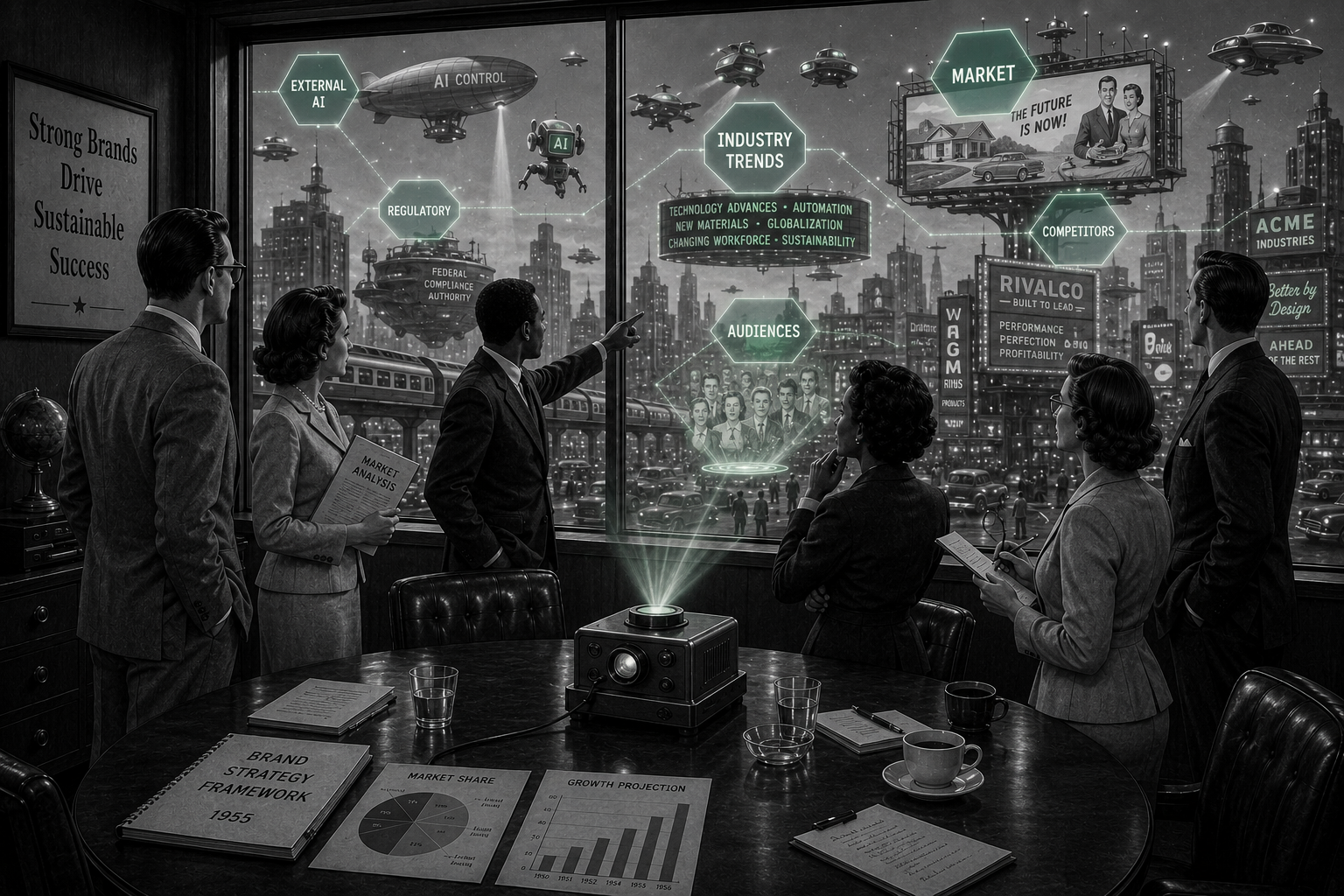
Environment is not just the market. The market is one domain inside it. Environment also includes the audiences your brand is trying to reach, the competitors fighting for the same attention, the industry trends shifting under everyone's feet, the regulatory pressures shaping what you can and can't do, and the External AI layer that increasingly mediates how every brand gets found and described. A team that confuses Environment with "market data" is missing five-sixths of the picture.
Environment is also not neutral. The way your brand reads its context — which signals it weights, which competitors it watches, which audiences it counts as legitimate — is shaped by Brand DNA. A boutique brand and a mass-market brand looking at the same data will see different Environments, because Brand DNA filters which signals are relevant to which kind of pursuit. Reading the field is an act of identity, not just observation.
How Environment Operates within the Brand Biome Model
Environment takes in signal continuously from outside the system and feeds calibration to the rest of the Biome Model. The discipline lives in distinguishing signal from noise — and remembering that not every shift requires a response.
The world doesn't pause for your strategic planning cycle. Markets shift, competitors move, audiences change preferences, and AI engines rewrite how brands get found — all in real time. The Environment node is where your team's ongoing sensing of these shifts gets organized, named, and made available to the rest of your system.
Won/lost analysis, churn patterns, dark funnel mentions, and reviews are Environment signal — they tell you how your brand is actually being perceived in the field, not how you wish it were. These signals refine your read of Environment over time and surface drift between what you intend and what the world hears.
When Environment moves, Goals and Strategies need to move with it — sometimes. The outflow is calibration, not reaction: a regulatory shift, a new competitor, an algorithm change feeds into the operating loop quarterly, where you decide which Environmental moves are durable enough to adjust the plan against.
Brand DNA decides which Environmental signals are even relevant. A premium brand watching mass-market discount activity is reading noise; a mass-market brand ignoring price compression is missing signal. DNA is the filter that tells you which signals belong in your Environment read — and which belong in someone else's.
The Six Domains
Six domains compose Environment. Not every brand watches all six closely; the set below is a reasonable default, tuned to your brand in the engagement.
Domain 01
Market
The category landscape your brand competes in — size, structure, growth, and direction.
Market
Domain 02
Competitors
The brands fighting for the same attention, dollars, or position — directly or by substitution.
Competitors
Domain 03
Audiences
The people your brand is trying to reach — who they are, how they decide, and what they're paying attention to.
Audiences
Domain 04
External AI
How AI engines find, summarize, and recommend your brand — the newest domain in Environment, and among the fastest-moving.
External AI
Domain 05
Industry Trends
The broader shifts shaping the field over multi-quarter horizons — adjacent to your category, not in it.
Industry Trends
Domain 06
Regulatory
The laws, policies, and compliance constraints that shape what your brand can and can't say, sell, or store.
Regulatory
Working Discipline
Environment doesn't get assessed weekly. The signal is too noisy at that cadence — what looks like a trend in one week is often variance. Environment moves on the quarterly operating loop, with a deeper scan twice a year.
A common failure mode: your team sees a competitor move and treats it as an Environmental shift. Most competitor moves are tactical — a campaign, a feature, a price test. They're worth tracking but not worth recalibrating against. The discipline is to distinguish a moment from a movement, and let the system absorb the difference before adjusting the plan.
Environmental scanning produces volume. Most teams have more signal than they can act on. The recalibration cycle filters those signals through Brand DNA and operating Goals — only the signals that change what you're pursuing, or how you're pursuing it, earn time in the next planning conversation.