
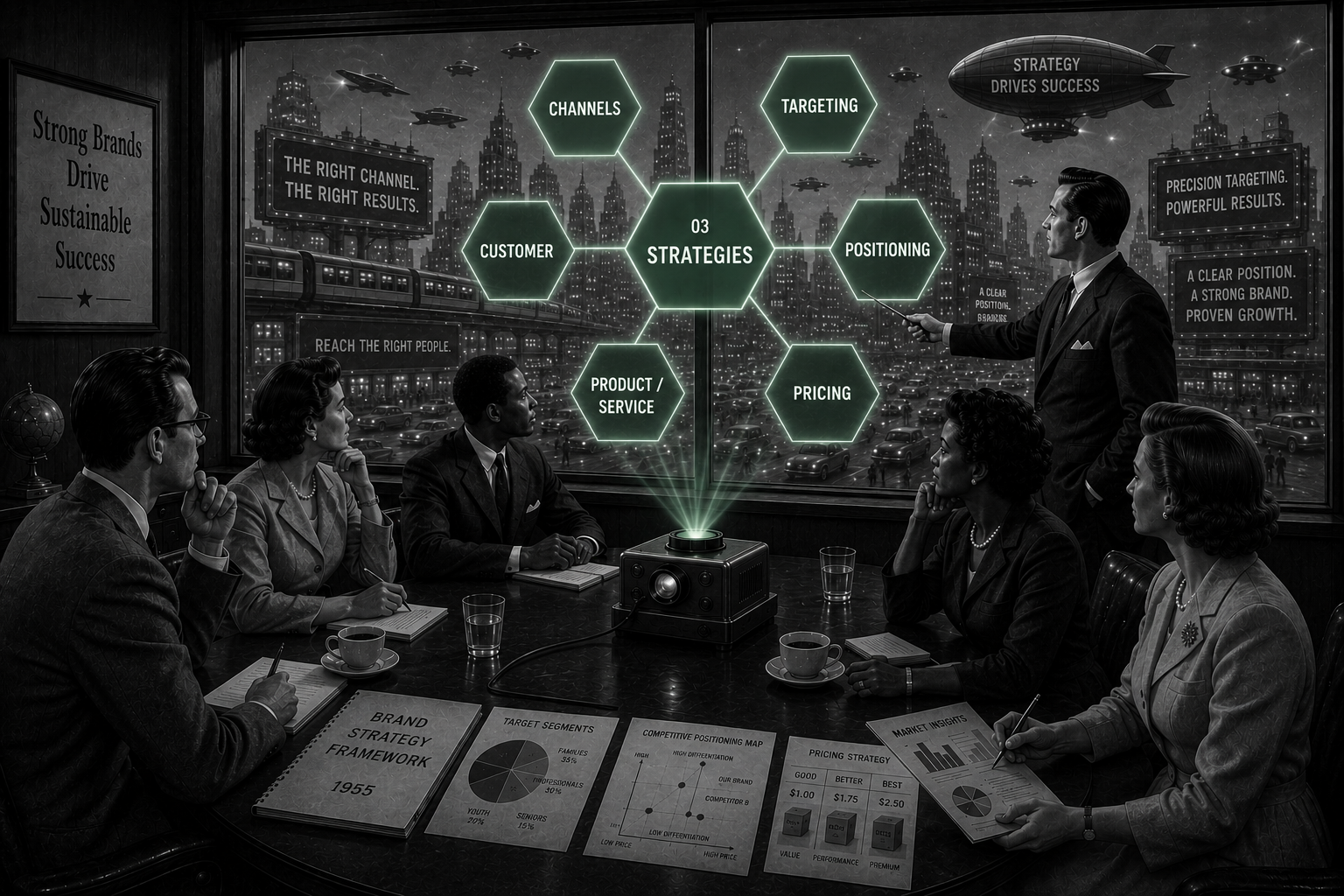
03 STRATEGIES
How You Plan to Achieve Your Goals
STRATEGIES
How your brand plans to achieve its Goals. The decisions that translate Brand DNA into deliberate, directional action.
The Role of Strategies — Plotting the Course
Strategies are the deliberate choices your brand makes to translate Brand DNA and current Goals into plans your team can execute against.
Goals tell you where to go. Environment tells you where you are. Strategies tell you how to get from one to the other — through which channels, to which audiences, at what price, with what message. Without Strategies, your brand has direction without a path; with Strategies, your team has a defensible answer to why this, and not that.
Strategies are not tactics. A campaign idea is a tactic; the positioning choice that determines which campaign ideas are even relevant is a Strategy. A media buy is a tactic; the channel mix that determines what kinds of media buys are coherent is a Strategy. Confusing the two is one of the most expensive failure modes in marketing — teams iterate on tactics inside a Strategy that's already broken, polishing the execution of the wrong plan.
Strategies are also not infinite. The space of legitimate Strategy choices for your brand is bounded by Brand DNA. A Strategy that requires your brand to violate its own DNA isn't a clever pivot — it's a plan to dilute the asset that makes your brand worth something. Brand DNA is the filter that determines which Strategies are coherent with your brand — and which would erode it in pursuit of the Goals.
How Strategies Operate within the Brand Biome Model
Strategies receive two kinds of inflow and send one kind of outflow. The discipline lives in keeping Strategy work distinct from execution work — and recognizing when the difference has collapsed.
Goals tell you the destination. Environment tells you the terrain. Together they define the problem your Strategies are solving — and any Strategy proposed without explicit reference to both is solving a problem nobody set. The discipline is naming the inflow when you commit to a Strategy, so you know what to revisit when either input changes.
Won/lost analysis, retention patterns, dark funnel mentions, and word of mouth refine your read of which Strategies are actually working in the field. Customer Signal is the operational sensor on Strategy effectiveness — and the place where a Strategy gets corrected before it becomes a quarter of wasted Execution.
Every Execution choice — every campaign, every channel investment, every content decision — must trace back to a Strategy. If it doesn't, you're producing activity without intent. The outflow from Strategies to Execution is your Biome Model's most operationally visible relationship, and the one most prone to drift if not actively maintained.
Brand DNA doesn't choose Strategies, but it determines which Strategies are legitimate. A premium positioning Strategy for a value-brand DNA is a category error, not a bold move. DNA is the filter that tells you which Strategies are coherent with your brand — and which would require pretending to be a different brand to execute.
The Six Domains
Six domains compose Strategies. Not every brand weights all six equally; the set below is a reasonable default, tuned to your brand in the engagement.
Domain 01
Channels
The distribution paths your brand chooses to reach its audiences — owned, earned, paid, partnered.
Channels
Domain 02
Targeting
The decision of who your brand will speak to — and, just as critically, who it won't.
Targeting
Domain 03
Positioning
The space your brand chooses to occupy in your audience's mind — relative to competitors and alternatives.
Positioning
Domain 04
Customer
The deliberate operational use of customer signal — won/lost, retention, dark funnel, word of mouth — to calibrate Strategy in flight.
Customer
Domain 05
Pricing
The economic position your brand chooses — and the signal it sends about who the brand is for.
Pricing
Domain 06
Product / Service
The deliberate choices about what your brand sells — scope, depth, configuration, and the shape of the offer itself.
Product / Service
Working Discipline
Strategies don't change in response to weekly performance. They hold through the operating loop until the inflows — Goals, Environment, or Customer Signal — give you a reason to recalibrate, or until enough Executions have failed against a Strategy to indict the Strategy itself.
A common failure mode: your team sees a tactical miss and treats it as a Strategy failure. A campaign underperforms, an A/B test goes the wrong way, a launch lands quietly — and the team reaches for the Strategy itself rather than examining whether the Execution served the Strategy faithfully. The discipline is to separate Strategy failure (the plan was wrong) from Execution failure (the plan was right, the delivery missed).
Strategy reset happens deliberately — typically on the same operating loop that recalibrates Goals: quarterly review, semi-annual reset, annual deep planning. Between those triggers, the work is to honor the Strategies in place, run Executions that serve them, and gather the signal that will inform the next recalibration cycle.