
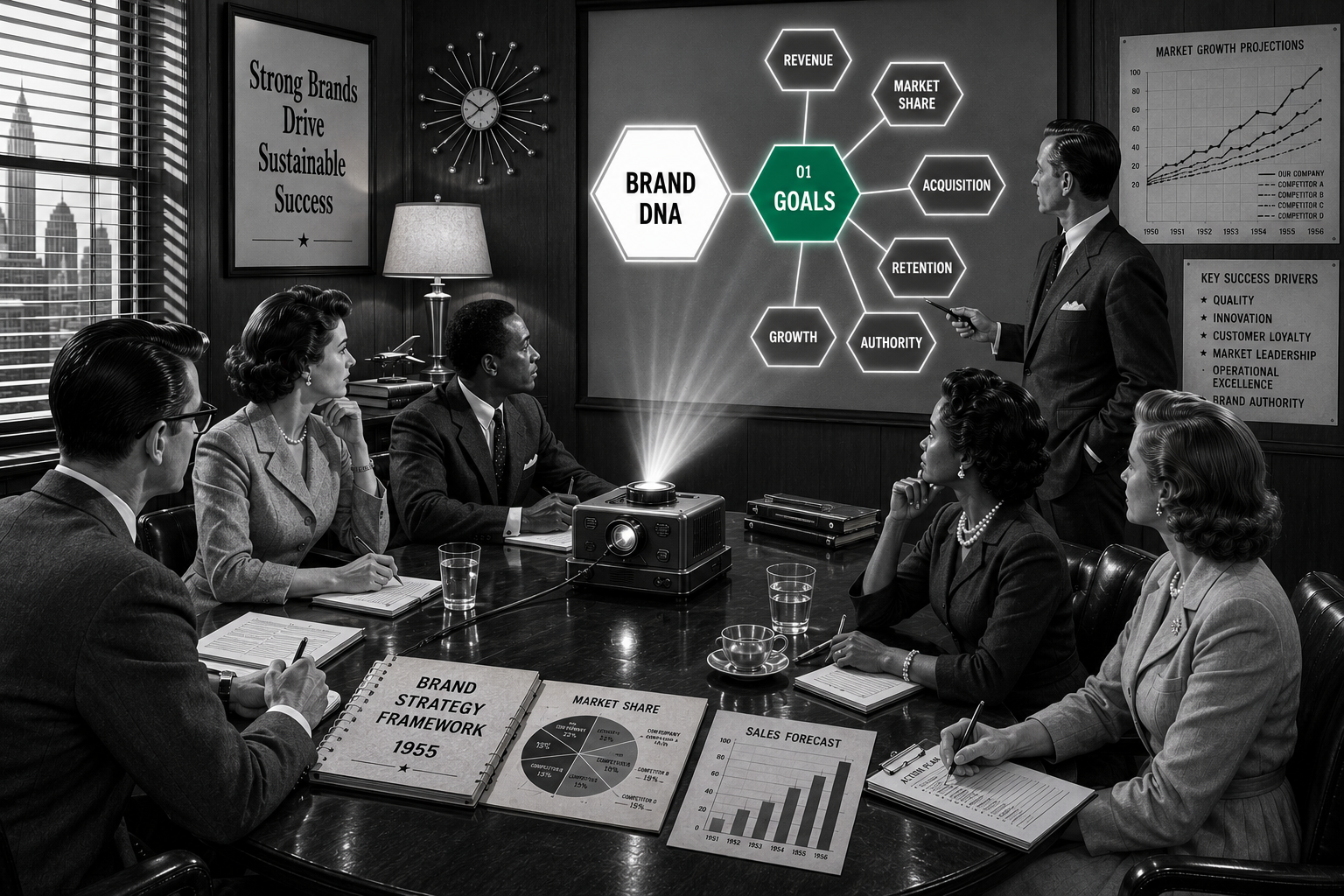
01 GOALS
The ‘What’ Directing Your Brand DNA Model
GOALS
What your brand strives to achieve. The outcomes the rest of your Biome Model is built to deliver.
The Role of Goals — Pointing the System
Goals are the desired business outcomes your brand is committed to pursuing — what your marketing system is trying to make true.
Strategies follow from Goals. Environment is what Goals are measured against. Execution is how Goals get pursued. Without defined goals, every other node in your Biome Model lacks direction — and any audit, plan, or campaign is just motion, not progress.
Goals are not KPIs. KPIs measure progress toward Goals; Goals are the outcomes your brand is reaching for. Confusing the two is one of the most common failure modes in marketing systems — your team optimizes a dashboard instead of optimizing for goals, and a year later you're wondering why the numbers improved while your business didn't.
Goals are also not arbitrary. They sit within the boundaries of who your brand is. If you're a boutique, you don't set Goals that require abandoning boutique. Brand DNA is the filter that determines which Goals are coherent with your brand — and which would erode it in pursuit of growth that doesn't fit.
How Goals Operate within the Brand Biome Model
Goals receive two kinds of inflow and send one kind of outflow. The discipline lives in honoring the difference between them.
Your leadership sets the agenda — growth phase, revenue targets, market expansion, new-product bets. These come from board conversations and strategic planning, not from marketing performance data. Your marketing system operates against these decisions; it doesn't set them.
When Environment moves significantly, or when Strategies can't deliver against current Goals on the timeline your business needs, Goals themselves get recalibrated. This is the operating loop — quarterly or semi-annually, you check whether the goals and goal levels still make sense given what the world has done.
Every Strategy you choose must answer the question which Goals does this serve? If it doesn't answer cleanly, it doesn't belong in your plan. Strategy that doesn't trace back to Goals is activity dressed up as direction.
Brand DNA doesn't set Goals, but it determines which Goals are legitimate. Goals that require your brand to violate its own DNA aren't Goals worth pursuing — they're a signal that either the Goals need to change, or your brand has outgrown its DNA. The latter is rare and a deliberate decision when it happens.
The Six Domains
Six domains compose Goals. Not every brand uses all six; the set below is a reasonable default, tuned to your brand in the engagement.
Domain 01
Revenue
The top-line financial target — most measurable, often loudest, not always the most strategic.
Revenue
Domain 02
Market Share
Position within a defined category. The discipline is naming the category honestly.
Market Share
Domain 03
Acquisition
New customer or prospect inflow. Two parameters matter — volume, and quality.
Acquisition
Domain 04
Retention
Keeping the customers you already have. The cheapest growth lever and the most honest brand DNA signal.
Retention
Domain 05
Growth
Direction-setting expansion — new markets, new products, new segments.
Growth
Domain 06
Authority
Your brand's position in the conversation — citations, references, the quality of the mentions.
Authority
Working Discipline
Goals don't move on a bad week. They hold long enough for Strategies and Execution to deliver against them.
A common failure mode: your team sees a metric move the wrong direction and reaches for the Goals to lower them. That's noise interrupting signal. The discipline is to hold the Goals, examine whether the Strategies serving them are sound, and let the system iterate before making adjustments to your model.
Recalibration happens on a deliberate cadence — typically quarterly or semi-annually. Reset happens only on major business events: a new market entry, new leadership, a true repositioning. Outside those triggers, the cadence is recalibration — adjusting numbers, not direction.