Brand NUCLEUS
WHERE Elements FORM YOUR UNIQUE IDENTITY
BRAND NUCLEUS
A unique archetype composition at the center of your Brand Biome Model. It shapes the seven Brand DNA Strands around it, and everything the other four components express, read through, translate, and ship.
The Brand Nucleus: Your Archetype Composition
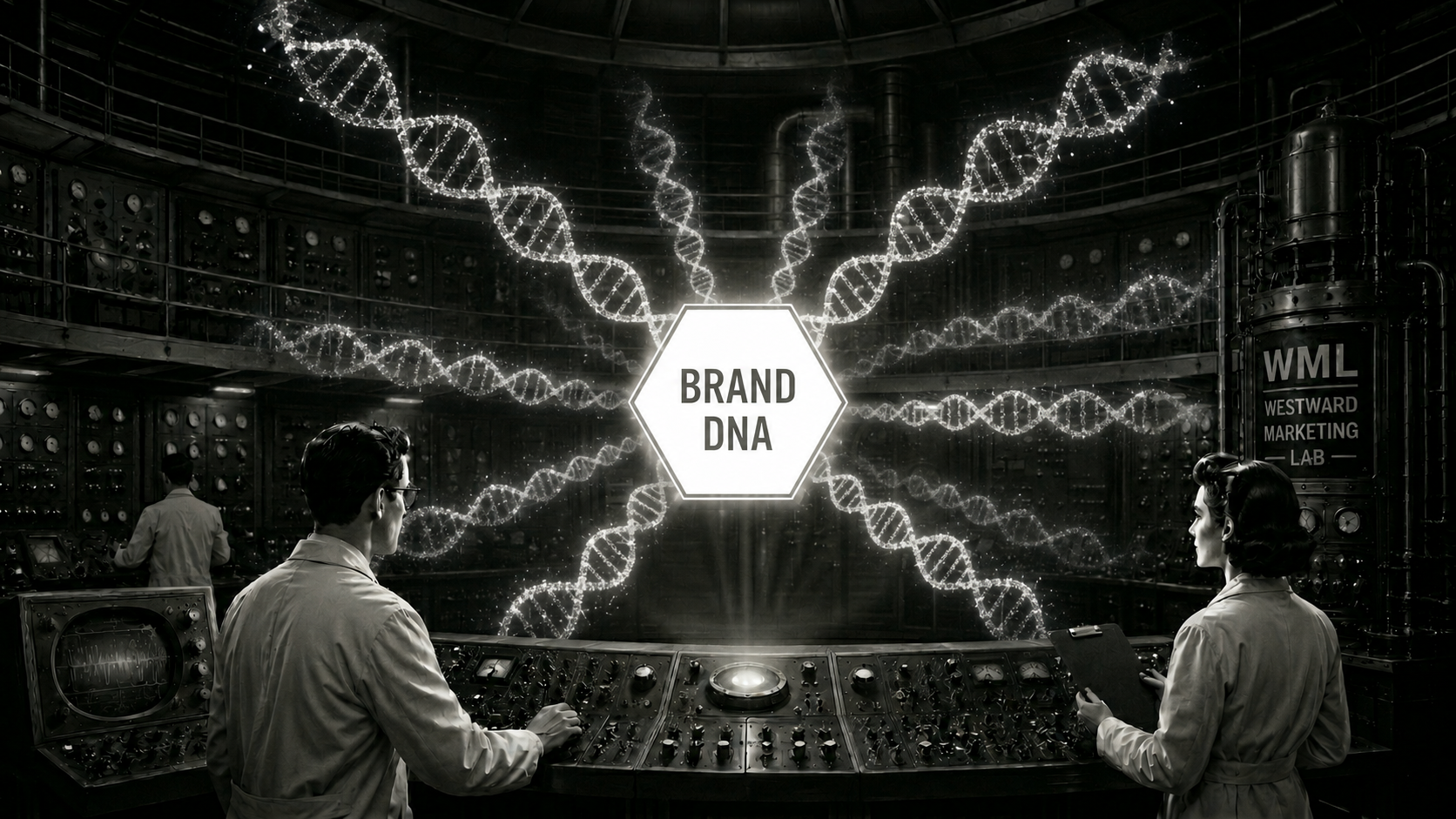
At the center sits a pattern no other brand shares: the specific mix of the 12 Brand Archetypes that makes your brand recognizably itself. Every brand is a composition, not a single archetype. That composition is your Brand Nucleus, and it shapes each of the seven Brand DNA Strands around it.
The 12 Brand Archetypes — Innocent, Explorer, Sage, Hero, Outlaw, Magician, Everyman, Lover, Jester, Caregiver, Ruler, and Creator — are universal narrative patterns, the same ones that show up in myth, film, and the brands people already trust without being able to say why. No brand is purely one. Most read as a primary archetype with one or two secondary archetypes in support — a Hero brand with Sage undertones, a Caregiver brand with a Creator edge. That specific mix is your Brand Nucleus: the brand's deepest, most stable layer of identity.
An example Brand Nucleus: a primary Hero archetype with strong Sage support and a light Ruler undertone. Every real Brand Nucleus is diagnosed for the specific brand; this is one illustrative shape among many.
Hero
Courageous and determined — seeks to prove worth through courageous acts, valuing mastery and triumph over adversity.
Appeals to people who want to prove something to themselves or others — taps into the desire for mastery and the self-respect earned through real effort.
Sage
Wise and knowledgeable — seeks truth and understanding, valuing expertise and clarity over guesswork.
Appeals to people facing a complex or uncertain decision — reduces anxiety by offering the reassurance that an expert has genuinely thought it through.
Ruler
Controlled and responsible — seeks to create order and stability, valuing leadership and excellence.
Appeals to people who value control and predictability — validates the desire for status and order, and the confidence that things won't spiral.
Magician
Transformative and visionary — seeks to make dreams reality, valuing innovation and transformative experiences.
Appeals to people who want genuine transformation, not incremental improvement — taps into hope and the sense that something can fundamentally change for them.
Creator
Imaginative and artistic — seeks to build something of enduring value, valuing innovation and self-expression over convention.
Appeals to people who want to express themselves or build something lasting — taps into the desire for self-expression and legacy, not just consumption.
Outlaw
Rebellious and disruptive — seeks to overturn what isn't working, valuing revolution and freedom from convention.
Appeals to people who feel confined by rules or the status quo — validates frustration with "how things are supposed to be done" and gives permission to push back.
Explorer
Independent and adventurous — seeks freedom and new experiences, valuing authenticity and discovery over conformity.
Appeals to people who feel constrained by convention or routine — validates the desire to break from a prescribed path and discover something for themselves.
Caregiver
Compassionate and nurturing — seeks to protect and care for others, valuing service and generosity over self-interest.
Appeals to people who want to feel protected and cared for — taps into the desire for safety and unconditional support, especially when they feel vulnerable.
Everyman
Relatable and down-to-earth — seeks belonging and connection, valuing authenticity and common sense over elitism.
Appeals to people who want to feel like they belong, not singled out or judged — validates ordinariness and solidarity over exclusivity or status-seeking.
Lover
Passionate and intimate — seeks relationships and connection, valuing beauty and emotional bonds.
Appeals to people seeking deep connection — taps into the desire to feel specifically seen and valued, not treated as one more transaction.
Jester
Playful and humorous — seeks to bring joy and lightness, valuing fun and spontaneity over seriousness.
Appeals to people who want relief from stress or seriousness — gives permission not to take things too seriously and validates the desire for joy and levity.
Innocent
Optimistic, honest, and pure — seeks happiness and does things right, valuing simplicity and trust over cynicism.
Appeals to people who want reassurance and safety from complexity or cynicism — permission to trust a simple, good choice without having to second-guess it.
Your Brand Nucleus isn't chosen for effect. It's diagnosed. It comes from what the brand actually does in the world, who it serves, and what it's already been rewarded for being. Get it wrong and every strand built around it will feel slightly off, even when each strand looks correct in isolation. Get it right, and the seven Brand DNA Strands stop being seven separate decisions and start being seven expressions of the same underlying pattern.
This is why the Brand Nucleus sits at the center, with the seven Brand DNA Strands arranged around it rather than beside it as peers. Voice inherits its cadence from the nucleus. Visual inherits its palette and imagery logic. Narrative inherits its mythic shape — the kind of story the brand is even capable of telling. Values inherit their non-negotiables. Audience is whoever recognizes themselves in that composition. Promise is what that composition is trusted to deliver. Positioning is the claim only that composition, and no other, can credibly make.
The Seven Brand DNA Strands
Seven Brand DNA Strands surround your Brand Nucleus. They are the discrete, observable components of a brand's identity — each one expressible, each one measurable, each one capable of drifting independently of the others.
Each strand is where the Brand Nucleus becomes something a team can actually work with. The nucleus sets the pattern; the seven strands are how that pattern gets built, tested, and shipped — Voice makes it audible, Visual makes it visible, Narrative gives it a story, and so on through Values, Audience, Promise, and Positioning. Read the strands without the Brand Nucleus behind them and they can look like seven independent style choices. Read them with it, and they're seven expressions of one identity.
The strands are not equally weighted across every brand. A consumer brand may carry most of its identity in Voice and Visual; a B2B brand may carry more in Positioning and Promise. The work is identifying which strands hold the most weight for your brand, and making sure all seven stay coherent with each other — because a market that experiences a brand whose strands contradict each other reads that brand as untrustworthy without ever being able to articulate why.
Strand 01
Voice
How the brand sounds. The cadence, word choices, syntax rhythm, and tonal range that make a brand recognizable in a single sentence with the logo removed.
Voice
Strand 02
Visual
How the brand looks. Color, typography, image style, motion, and the spatial logic of how those elements combine across every surface.
Visual
Strand 03
Narrative
The story the brand tells about itself and the world it operates in. Origin, conflict, transformation, stakes — the through-line that gives every campaign and piece of content a place to sit.
Narrative
Strand 04
Values
What the brand stands for and stands against. The non-negotiables that filter every Strategy and Execution decision before they reach the field.
Values
Strand 05
Audience
Who the brand exists to serve, and just as importantly, who it doesn't. Audience clarity makes Strategy possible; audience ambiguity dissolves Strategy into marketing to everyone.
Audience
Strand 06
Promise
What the brand commits to deliver, every time. The promise customers can rely on without checking the fine print.
Promise
Strand 07
Positioning
Where the brand sits relative to alternatives. The deliberate claim about category, distinction, and the part of the market the brand is built to own.
Positioning
The Role of the Brand Nucleus — Holding the Source
The Brand Nucleus is the source at the center of your Brand Biome Model, and the seven Brand DNA Strands around it carry its pattern outward. Everything the four orbital components do — pointing toward Goals, reading the Environment, plotting Strategies, executing in the field — gets its weight from what's encoded here.
Your Brand Nucleus is not your mission statement, your tagline, or your visual identity. Those are expressions of it. The Brand Nucleus itself is the unique archetype composition that makes one brand recognizably different from another — even when both are saying similar things in similar markets — and the seven Brand DNA Strands are how that composition shows up as commitments, characteristics, and claims. It's what stays constant when everything else changes: the team, the product line, the channels, the campaigns.
Brands that operate with a clear Brand Nucleus compound over time. Every Strategy choice reinforces the last. Every Execution piece reads as part of a single, growing body of work. Brands without one run faster than they accumulate — they ship a lot, but the work doesn't add up. The market sees a series of disconnected campaigns rather than a brand becoming itself.
The Brand Nucleus, and the Brand DNA Strands it shapes, are what every other component of the Biome Model expresses, reads through, translates, and ships. Get them right and the orbital components have something coherent to work with. Get them wrong, or leave them implicit, and every downstream decision becomes harder than it needs to be.
How the Brand Nucleus Operates within the Brand Biome Model
The Brand Nucleus has no operational inflow. It is the source. Its outflow, carried by the seven Brand DNA Strands, radiates to all four orbital components — each of which translates it into its own work. The Customer signal feeds back through Strategies as calibration of expression, not revision of the Brand Nucleus itself.
Goals exist to express what the brand wants to achieve in the world. The Brand Nucleus is where that ambition comes from — the values, the promise, the positioning that make some Goals consonant with this brand and others off-key. A Goal that doesn't trace back to it is borrowed from another brand's playbook.
Environment is read through the lens of the Brand Nucleus. Two brands looking at the same market see different opportunities because they bring different identities to the read. The nucleus is what makes one signal salient and another irrelevant — it shapes your strategic peripheral vision before any analysis begins.
Every Strategy choice — which audience to serve, which channel to invest in, which positioning claim to make — gets its weight from the Brand Nucleus. Without that gravity, Strategy collapses into a menu of options ranked by feasibility. With it, Strategy becomes a set of decisions only this brand could justify.
Execution is where the Brand Nucleus becomes visible. Every piece of content, every campaign, every customer interaction either carries it outward through the seven strands or leaks it. The nucleus is what every Execution choice gets measured against — the constant that lets the market recognize the brand across every surface it shows up on.
Working Discipline
The Brand Nucleus moves slowest in the Biome Model. Goals shift quarterly. Strategies recalibrate against the Customer signal. Execution adapts weekly to the field. The Brand Nucleus changes only when the business itself changes at the level of identity — a merger, a pivot, a generation of leadership taking the brand somewhere it has never been.
The discipline at the center is protecting that stability while letting the seven Brand DNA Strands and the four orbital components evolve their expression of it. A team that revises its Brand Nucleus every time a campaign underperforms is not refining the brand — it's eroding it. A team that refuses to revisit it when the business has fundamentally changed is not protecting the brand — it's letting it ossify.
The signal that the Brand Nucleus needs work is rarely a single bad quarter. It's the pattern across multiple cycles: Strategies that keep landing flat, Execution that keeps feeling generic, Goals that no one can connect back to a reason. When the orbital components are all working harder for diminishing returns, the most likely cause is not at the edge — it's at the center.